Best Drone for Farming and Field Mapping
Published
Find the best drone for farming, from crop scouting and mapping to spraying. Compare aircraft types, sensors, support and UK operating needs for growers.
A wet patch spreading through an otherwise healthy field is rarely visible from the farm track. The right aerial view can show where to walk, sample and act before time and inputs are wasted. That is why the best drone for farming is not simply the aircraft with the longest feature list. It is the system that produces useful information for the decisions your farm needs to make.
For some growers, that means a compact camera drone for fast visual inspections. For others, it means a multispectral platform that supports crop-health analysis, or a dedicated agricultural aircraft for carefully planned application work. The correct choice starts with the job, the acreage and the workflow after the flight.
What is the best drone for farming?
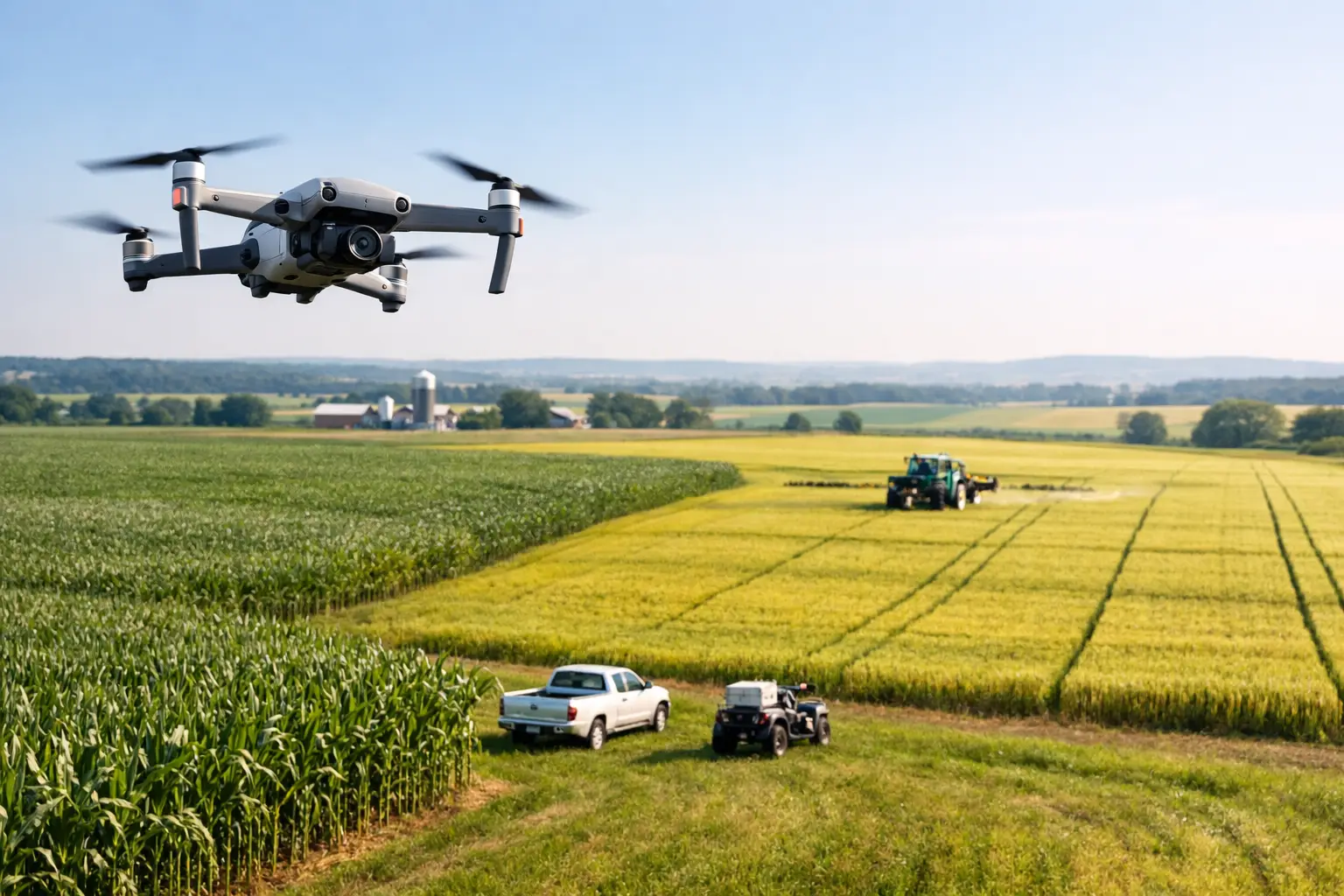
For general crop scouting and field awareness, a high-quality camera drone is often the most practical starting point. It lets a farmer or agronomist inspect drainage, crop establishment, storm damage, boundary issues and inaccessible areas without spending hours travelling across the holding. It is also a sensible route for capturing clear imagery to share with contractors, landowners or advisers.
Where the requirement is repeatable crop analysis rather than visual inspection alone, a multispectral drone is the stronger investment. These systems capture data beyond standard visible-light imagery, helping specialists identify variation in crop vigour and target ground checks more effectively. They are designed for measurement-led work, but they still rely on good planning, suitable processing software and an understanding of what the results can and cannot show.
A spraying drone is a separate purchasing decision. It is built for operational application work, with different payload, safety, maintenance and regulatory considerations to a mapping platform. It can make sense where terrain, crop type, access or labour availability make conventional methods difficult, but it should never be chosen simply because it is the largest aircraft in the range.
Start with the farming problem, not the drone
The fastest way to overspend is to buy an aircraft before defining the outcome. Ask what needs to change after the data has been collected. If the answer is, “We need to see which fields need a closer look,” a camera drone may be sufficient. If it is, “We need consistent crop-health layers across several blocks,” multispectral capability and a reliable processing workflow become more important.
Visual scouting is valuable because it is immediate. A pilot can check lodged crops, irrigation problems, standing water, damaged fencing and livestock access points, then act on what is visible. Standard camera imagery is also easier to interpret and quicker to introduce to an existing farm routine.
Multispectral surveying needs more discipline. Flights should be repeatable, captured in suitable conditions and processed consistently if you want to compare areas or dates with confidence. The data can highlight patterns, but it does not replace agronomic judgement, soil sampling or a field walk. Think of it as a way to direct expertise to the right place.
Application work demands the clearest business case of all. Consider the target crop, area to be treated, terrain, refill arrangements, battery management, operator competence and records required for your operation. The aircraft is only one part of an application system.
Choose the right type of agricultural drone
Camera drones for scouting and inspection
A camera drone suits farms that need a rapid, flexible overview. It can support routine crop walks, post-weather checks, roof and building inspections where appropriate, and imagery for planning work. The key consideration is image quality that remains useful when viewed on a larger screen, rather than chasing features that do not affect the decisions being made.
A compact platform is often easier to transport and deploy, which matters when a short flight needs to fit between other jobs. However, a smaller aircraft may not be the right fit where the work involves frequent missions over extensive land or needs specialist sensors. Convenience has value, but so does matching the tool to the workload.
Multispectral drones for crop analysis
Multispectral systems are purpose-built for growers, agronomists and contractors who need more than a visual photograph. A platform such as the DJI Mavic 3 Multispectral is aimed at collecting imagery that can be used in crop-health analysis and field mapping workflows.
The value lies in consistency. If you can capture the right data at the right time and turn it into information that informs scouting, nutrition decisions or disease investigation, the system earns its place. If there is no defined process for analysing and acting on the output, a standard camera drone may deliver better value initially.
Before committing, establish who will plan missions, process imagery and interpret the results. A contractor or agronomist may handle some of this work, while larger operations may want an in-house capability. Either route can work, provided responsibilities are clear.
Agricultural spraying platforms
Dedicated agricultural platforms, including DJI Agras systems, are for professional application operations rather than casual farm use. They can be valuable in difficult terrain or where targeted aerial application is operationally appropriate, but ownership brings a higher standard of planning, maintenance and operator training.
Do not treat spraying capability as an add-on to mapping. The work has different safety controls, logistics and legal responsibilities. Speak to a specialist before specifying a system, especially if you are evaluating payload requirements, support equipment or the full operating process.
The equipment around the aircraft matters
A drone is productive only when it is ready to fly safely and its output can be used. Batteries, charging arrangements, spare propellers, cases and a sensible storage routine all affect whether the aircraft is available when conditions are right. For field work, a reliable charging plan can be more useful than an extra feature on the aircraft itself.
For mapping, the workflow extends to the controller, mission-planning tools, storage and processing. Consider how imagery will be named, backed up and shared. A folder full of files is not a farm-management benefit. A clear process that identifies an issue, confirms it on the ground and records the action taken is.
Maintenance should be considered before purchase as well. Agricultural work exposes equipment to dust, moisture, uneven ground and frequent transport. A repair route, access to genuine parts and informed technical support protect the investment far better than treating the drone as a disposable camera.
Budget for ownership, not just purchase
The best-value farm drone is the one used often enough to improve decisions. That may mean starting with a capable camera platform and building experience before moving into multispectral surveying. It may also mean investing in the correct specialist system from the outset because the farm already has the people, processes and workload to justify it.
Factor in batteries, charging equipment, protection, software where required, training, maintenance and insurance. If you are replacing an older aircraft, a trade-in can help make an upgrade more manageable. Buying through a specialist also gives you a clearer route to technical advice and repair support when the equipment is working in demanding conditions.
Plan for lawful, responsible UK operation
Farm land is not automatically unrestricted airspace. The rules that apply depend on the aircraft, the intended operation and the location. Before flying, pilots should understand the relevant CAA requirements, check airspace and local restrictions, and assess the site properly.
Keep flights away from people who are not involved in the operation, respect neighbouring property and never assume a field is clear without checking it. Plan take-off and landing areas, account for livestock, maintain the appropriate visual awareness and stop if conditions change. For commercial, specialist or application work, obtain suitable professional guidance rather than relying on general online advice.
Get advice that reflects your farm
A productive conversation about an agricultural drone should cover crops, acreage, terrain, the people who will operate it and the decisions it needs to support. It should also address whether you need scouting imagery, multispectral data, application capability or a combination delivered through different tools.
Drone-Sales can help match an official DJI solution, accessories and ongoing support to that requirement, rather than pushing every grower towards the same aircraft. The right first step may be a straightforward camera drone. The right long-term system may be a more specialised platform. Either way, choose the equipment that gives you a clearer view of the next decision in the field.